Functional Neurology for ADHD: A Case Study of Objective Brain-Based Improvement
When parents seek care for a child with ADHD, they’re often looking for more than symptom management. They want to understand why their child struggles with attention, emotional regulation, impulsivity, and learning.
Here at Delta Neuro Health, our goal is to identify measurable neurological dysfunction and create individualized rehabilitation programs that target the underlying systems contributing to those challenges.
This case study follows the progress of an 11-year-old boy who demonstrated significant improvements in attention, behavior, eye movement function, primitive reflex integration, and executive functioning through personalized functional neurological care.
Importantly, his progress was not only noticed by his family, it was also documented through objective neurological testing.
Initial Concerns
When this young patient first presented to our office, his parents described ongoing challenges with:
- ADHD symptoms
- Poor sustained attention
- Behavioral dysregulation
- Impulsivity
- Emotional outbursts
- Executive functioning
- Difficulty completing schoolwork
A comprehensive functional neurological examination was performed to identify the neurological systems contributing to his symptoms.
What We Found
Our examination identified several measurable neurological deficits, including:
- Retained primitive reflexes
- Poor smooth pursuit eye movements
- Impaired saccadic eye movements
- Reduced visual stabilization
- Findings consistent with subtle developmental inefficiency within frontal lobe networks responsible for executive function, attention, and behavioral regulation
Rather than treating a diagnosis, we designed rehabilitation around these objective examination findings.
Objective Finding: Abnormal Smooth Pursuit Eye Movements
One of the most significant findings was impaired smooth pursuit eye movements.
Smooth pursuits allow the eyes to accurately follow moving objects without losing fixation. These movements are essential for reading, classroom learning, sports, and maintaining visual attention.
Using Video Nystagmography (VNG), we were able to objectively measure his pursuit performance before beginning care.
Before Treatment
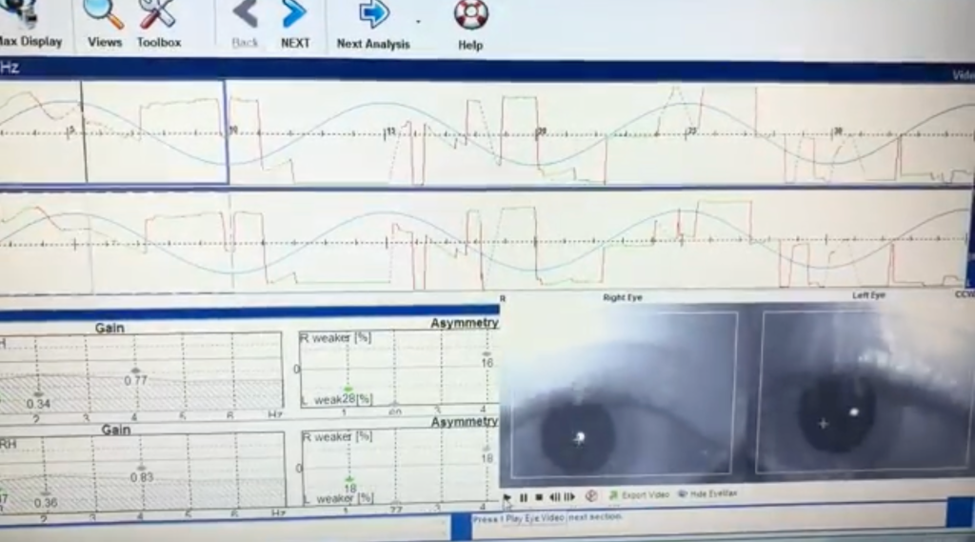
VNG Smooth Pursuit Testing (Initial Evaluation)
Caption: Baseline VNG testing demonstrated inaccurate smooth pursuit eye movements with reduced stability and tracking accuracy.
Following his individualized rehabilitation program, repeat VNG testing demonstrated a dramatic improvement.
After Treatment
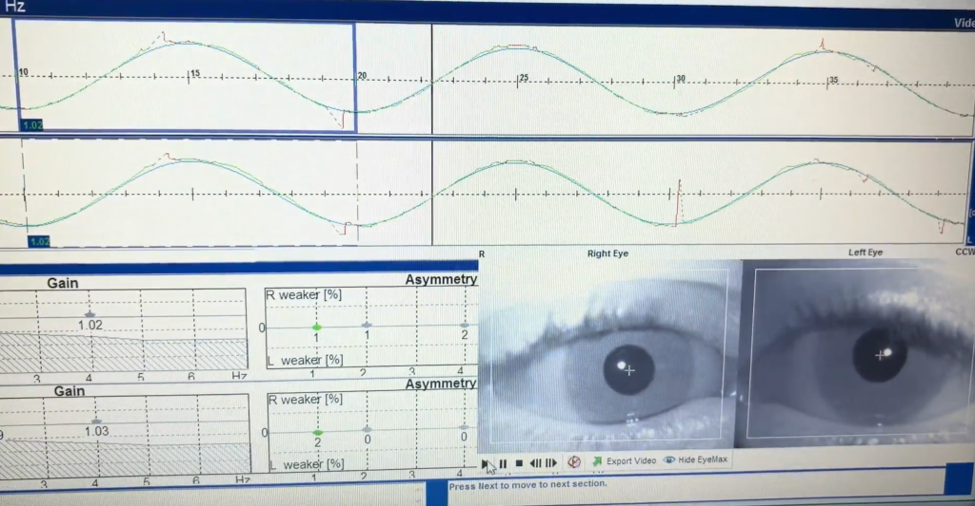
VNG Smooth Pursuit Testing (Post-Treatment)
Caption: Follow-up VNG demonstrated markedly improved pursuit accuracy and visual stabilization after neurological rehabilitation.
The Treatment Approach
Treatment focused on improving the neurological systems identified during the examination.
His individualized rehabilitation program emphasized:
- Eye stabilization exercises
- Smooth pursuit rehabilitation
- Saccadic eye movement training
- Primitive reflex integration strategies
- Frontal lobe activation exercises
- Executive function rehabilitation
- Sensory integration
- Balance and postural control
Every treatment session was customized according to his ongoing neurological progress.
The Results
By the completion of care, his parents reported meaningful improvements in:
- Sustained attention
- Emotional regulation
- Impulse control
- Behavioral consistency
- Confidence
- School participation
- Ability to complete tasks independently
Repeat neurological examination also demonstrated:
- Significant improvement in smooth pursuit eye movements
- Improved saccadic accuracy
- Better visual stability
- Reduced primitive reflex expression
- Improved frontal lobe performance during examination
- Better overall neurological integration
The combination of parental observations and objective neurological testing painted the same picture: meaningful functional improvement.
Why Objective Testing Matters
One of the greatest advantages of functional neurology is the ability to measure many aspects of nervous system function over time.
Rather than relying solely on symptom reports, objective tools such as:
- Video Nystagmography (VNG)
- Eye movement testing
- Primitive reflex examination
- Cognitive performance testing
- Symptom severity assessments
allow clinicians and families to track neurological changes throughout rehabilitation.
While no single test tells the entire story, combining objective findings with a comprehensive neurological examination helps guide individualized treatment and monitor progress.
Eye Stability Affects Attention
Imagine for a moment that you are your child. You sit down to work on a math problem or read a paragraph, and you genuinely want to pay attention. But your eyes aren’t able to comfortably and consistently stay on the target. The words seem to move, your eyes have to make constant small corrections, and maintaining your place takes far more effort than it should. After a few minutes, your brain is working overtime just to keep the visual system stable—before you’ve even had a chance to think about the math problem or understand what you’re reading. Frustration begins to build. You become tired. You lose your place. You look away. Maybe you get up, become restless, or say, “I don’t want to do this.”
From the outside, it can look like inattention, impulsivity, defiance, or a lack of motivation. But what if that’s not what’s actually happening?
What if your child isn’t refusing to focus, they’re struggling to physically maintain the visual focus required to focus?
This distinction is incredibly important. A child with unstable smooth pursuit eye movements may know exactly what they’re supposed to be doing. They may be intelligent, motivated, and genuinely want to succeed. The problem may not be that they can’t understand the material or don’t want to do the work. Their visual system may simply be making it unnecessarily difficult for their brain to maintain attention.
When the eyes are constantly making corrective movements, the brain has to devote additional resources to keeping the visual world stable. That leaves fewer resources available for the things we actually want the child to be doing, reading, solving the problem, listening to the teacher, remembering instructions, and learning.
This is why we believe it is so important to look beyond the behavior.
Before we label a child as “inattentive,” “lazy,” “defiant,” or “unable to sit still,” we should ask whether their nervous system is giving them the ability to comfortably sustain attention in the first place.
For some children, the issue isn’t a lack of intelligence. It isn’t a lack of effort. And it isn’t simply a behavioral problem.
It may be that their eyes aren’t providing their brain with a stable enough target to make sustained attention easy.
When we identify and address deficits in smooth pursuit and visual stability, we aren’t trying to make a child “try harder.” We’re working to make the neurological task of maintaining visual attention more efficient, so that the child can spend less energy trying to stabilize their eyes and more energy doing what they are capable of doing: learning, thinking, participating, and succeeding.
Looking for Functional Neurology for ADHD in Ohio?
Every child deserves an individualized evaluation and care plan, not just a diagnosis.
If your child struggles with ADHD, behavioral regulation, eye tracking, executive functioning, retained primitive reflexes, or learning challenges, a comprehensive functional neurological examination may help identify opportunities for personalized rehabilitation.
At Delta Neuro Health, we use advanced neurological assessment and evidence-informed rehabilitation to help patients improve brain function, visual performance, balance, attention, and quality of life.
Frequently Asked Questions
Can functional neurology help children with ADHD?
Functional neurology aims to identify specific neurological dysfunctions that may contribute to attention, executive functioning, visual processing, or motor control challenges. Treatment is individualized, and results vary based on each patient’s unique neurological findings.
Why are eye movements evaluated in children with ADHD?
Eye movements play an important role in reading, learning, visual attention, and processing information efficiently. Identifying deficits in pursuits or saccades can help guide rehabilitation when clinically appropriate.
What is Video Nystagmography (VNG)?
VNG is a non-invasive technology that objectively measures eye movements. It can provide valuable information about visual tracking and vestibular function as part of a comprehensive neurological evaluation.
Disclaimer: This case study reflects the experience of a single patient. Individual outcomes vary, and no specific result can be guaranteed. Clinical decisions are based on each patient’s history, examination findings, and individualized treatment plan.