Dizziness doesn’t always come from the inner ear. For some people, the neck may be playing a key role. Understanding how the neck, eyes, and vestibular system work together may provide an important piece of the puzzle.
Is Your Neck Making You Dizzy? Understanding Cervicogenic Dizziness
By Dr. Carly Carafa, DC, DACNB
Dizziness and vertigo are common symptoms, affecting approximately 15–20% of adults. There are many potential causes of dizziness, with vestibular (inner ear), cardiovascular, neurological, and other medical conditions all potentially contributing (Neuhauser, 2016).
Chronic dizziness can be difficult to diagnose and treat. Often, there isn’t one single cause. Multiple diagnoses can overlap, other health conditions can affect symptoms, and the sensation of dizziness can change over time. One person may describe feeling like the room is spinning, while another may describe feeling “floaty,” lightheaded, or off balance.
Today, I’ll focus on a specific type of dizziness: cervicogenic dizziness. This remains a somewhat controversial diagnosis because there is no single test that can definitively diagnose it. Instead, it is generally considered a diagnosis of exclusion, meaning other potential causes of dizziness need to be considered and ruled out first (Reiley et al., 2017). Although difficult to diagnose, we often see it in our office.
How Can the Neck Contribute to Dizziness?
Cervicogenic dizziness is thought to be related to the cervical spine, muscles, and surrounding tissues and how they communicate information to the brain.
Our muscles and joints constantly send information to the brain about where our body is in space. This is called proprioception. The proprioceptive system works together with our visual and vestibular systems to help the brain understand where our head and body are and how we’re moving.
Ideally, these three systems agree with one another. However, neck pain, injury, inflammation, muscle dysfunction, or changes in movement can potentially alter the information coming from the cervical spine. This may create a mismatch between the information coming from the neck, eyes, and inner ear, contributing to dizziness or imbalance in some individuals (Li et al., 2022).
This can be seen following injuries such as whiplash or concussion, as well as with chronic neck pain and reduced cervical mobility. Research has also suggested that people with persistent neck pain may become more reliant on visual information to maintain their balance and orientation. (Frontiers in Neurology, 2025)
What Does Cervicogenic Dizziness Feel Like?
In my clinical experience, many patients with suspected cervicogenic dizziness describe a “floaty” or “off-balance” feeling rather than classic vertigo, where the patient feels like the room or their body is spinning.
Other common symptoms can include:
- Feeling unsteady or off balance
- Dizziness with certain neck movements or positions
- Neck pain or stiffness
- Decreased range of motion in the neck
- Difficulty feeling oriented in space
However, the way dizziness feels alone cannot determine its cause. This is why a thorough evaluation is important.
How Do We Evaluate It?
At Delta Neuro Health, we look at the entire picture rather than assuming dizziness is coming from the neck.
Depending on the patient’s symptoms, our examination may include:
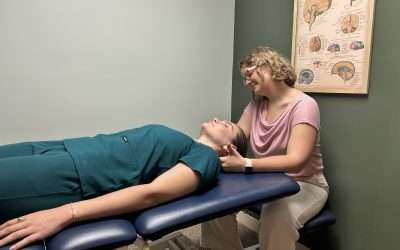
- Cervical range of motion: Looking for pain, stiffness, restricted movement, or dizziness with movement
- Cervical and muscle palpation: Assessing the neck and surrounding musculature
- Cervical joint position sense: Evaluating cervical proprioception
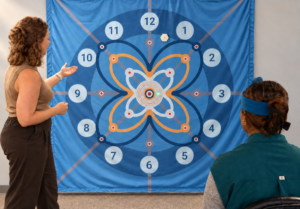
- Oculomotor testing: Assessing eye movements and visual function
- Balance testing: Looking at how the visual, vestibular, and proprioceptive systems work together
- VNG (videonystagmography): When appropriate, assessing vestibular and eye-movement function
There isn’t one test that says, “This is cervicogenic dizziness.” Instead, we use the examination to determine whether the cervical spine may be contributing to the patient’s symptoms while also looking for other potential causes.
What About Treatment? A Clinical Example
Treatment depends on what we find during the examination. If the cervical spine appears to be contributing to someone’s dizziness, treatment may include cervical mobility and strengthening exercises, proprioceptive training, eye-head coordination, balance exercises, and vestibular rehabilitation.
Recently, I had a patient come in with a presentation that was consistent with cervicogenic dizziness with POTS. His symptoms began following a concussion and included neck and shoulder pain, decreased cervical range of motion, neck stiffness, and a “floaty” sensation that was especially noticeable when turning his neck.
His treatment plan included a combination of:
- Proprioceptive exercises
- Cervical and shoulder soft-tissue techniques
- Cervical manipulation
- Tilt-table therapy
- Cognitive training
With treatment, the patient reported a decrease in his dizziness and other symptoms, which was also reflected in his objective measures.
The goal isn’t simply to “fix the neck.” Instead, we’re working to improve how the neck, eyes, vestibular system, and brain communicate and work together. For patients with dizziness, addressing this connection can be an important part of the rehabilitation process. Cervicogenic dizziness is still an evolving area of research, but understanding the connection between the neck and balance can be an important piece of the puzzle for patients experiencing both neck symptoms and dizziness.
If you’re experiencing dizziness along with neck pain, stiffness, or symptoms that change with head or neck movement, a comprehensive evaluation can help determine what systems may be contributing to your symptoms.
Sources
De Hertogh, Willem, et al. “Dizziness and Neck Pain: A Perspective on Cervicogenic Dizziness Exploring Pathophysiology, Diagnostic Challenges, and Therapeutic Implications.” Frontiers in Neurology, vol. 16, 2025, article 1545241, https://doi.org/10.3389/fneur.2025.1545241.
Li, Yongchao, et al. “Proprioceptive Cervicogenic Dizziness: A Narrative Review of Pathogenesis, Diagnosis, and Treatment.” Journal of Clinical Medicine, vol. 11, no. 21, 2022, article 6293, https://doi.org/10.3390/jcm11216293.
Neuhauser, H. K. “The Epidemiology of Dizziness and Vertigo.” Handbook of Clinical Neurology, vol. 137, 2016, pp. 67–82, https://doi.org/10.1016/B978-0-444-63437-5.00005-4.
Reiley, Alexander S., et al. “How to Diagnose Cervicogenic Dizziness.” Archives of Physiotherapy, vol. 7, 2017, article 12, https://doi.org/10.1186/s40945-017-0040-x.
Interested in an assessment or a free phone consultation?
Call us at 614-706-2093 or visit www.deltaneurohealth.com to schedule a consultation.